
Commercial teams know the routine – the results come in, they’re reviewed, a change stands out, and someone agrees to investigate further. Finance validates the calculation, sales adds customer context, an analyst pulls more detail and the team eventually understands what happened and begins discussing what to do next.
The process worked, at least on paper.
But by the time the answer is clear, the promotion ended, the customer plan moved forward or another reporting period began. The team learned something useful, but too late to influence the decision that produced the result.
Performance reports and review show what happened vs a structured performance feedback cycle that uses what happened to improve what comes next.
A structured, purpose-driven performance feedback cycle connects six essential steps:
Measure what matters. See what changed. Understand why. Guide based on learnings. Align ownership. Act while it matters.
None of the steps are new on their own. Commercial leaders already know they need to measure performance, investigate results and adjust their plans. The challenge they face is how to practically connect those activities into the overall operating rhythm.
When there’s a break in the cycle, performance improvement is forced to look backward, remaining retrospective. When it’s complete, clear and timely, it supports daily work, helping the organization to make optimal decisions on what comes next.
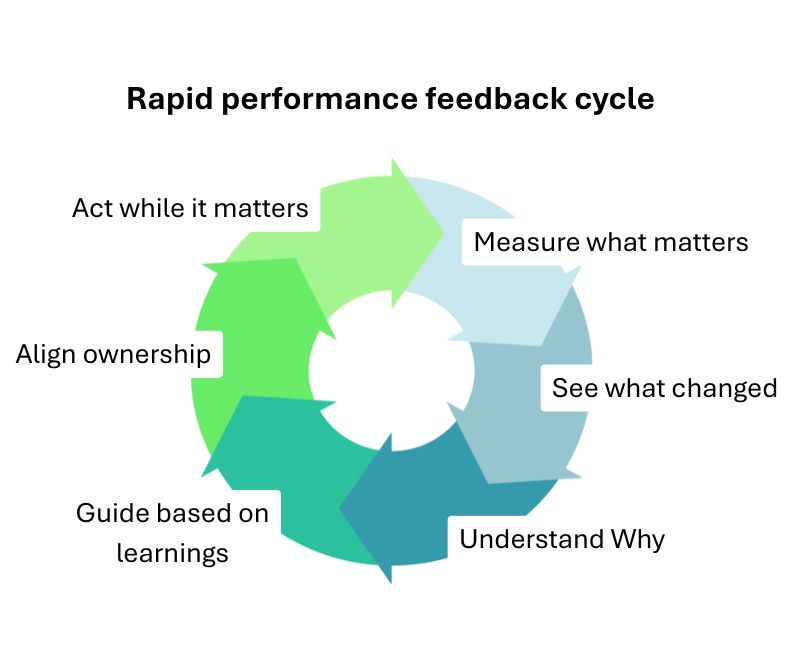
A structured, purpose-driven performance feedback cycle connects six essential steps:
Measure what matters. See what changed. Understand why. Guide based on learnings. Align ownership. Act while it matters.
None of the steps are new on their own. Commercial leaders already know they need to measure performance, investigate results and adjust their plans. The challenge they face is how to practically connect those activities into the overall operating rhythm.
When there’s a break in the cycle, performance improvement is forced to look backward, remaining retrospective. When it’s complete, clear and timely, it supports daily work, helping the organization to make optimal decisions on what comes next.
When there’s a break in the cycle, performance improvement is forced to look backward, remaining retrospective. When it’s complete, clear and timely, it supports daily work, helping the organization to make optimal decisions on what comes next.
1. Start with measures connected to business value.
Every feedback cycle begins with measurement. However, measurement alone doesn’t necessarily produce a clear view of performance. It takes context to truly understand value.
Commercial organizations manage a wide range of priorities. Sales may focus on volume and customer growth. Finance tracks margin and profitability. Category teams monitor assortment, velocity and promotion performance. Operations looks at efficiency, availability and cost-to-serve.
Each measure serves a purpose. Problems emerge when the measurements don’t connect to the same definition of business value.
A sales initiative may increase volume while weakening margin. A promotion may lift one product while reducing sales of a more profitable companion item. An operational change may lower delivery costs but create availability problems for an important customer.
In each case, one function may appear successful while the broader business result moves in the wrong direction.
A strong feedback cycle doesn’t eliminate functional priorities. It connects them.
Teams need measures that reflect their responsibilities while showing how their decisions affect profit and growth. That gives people a shared basis for evaluating tradeoffs instead of defending whichever metric makes their function look most successful.
The first question shouldn’t be, “Which numbers can we report?” It should be, “What does good performance mean for this decision?”
That answer creates the foundation for every step that follows.
2. Move from seeing a change to understanding its cause
Once the organization defines what matters, it must have the capacity to recognize when performance changes.
Reports and dashboards are useful here – they can indicate a shift in margin, promotion variance, a distribution gap or a change in route performance. And they help teams see where attention may be required.
But a signal isn’t an explanation.
Consider a promotion that produced a significant increase in volume. At first glance, the program appears successful. Before the business repeats the promotion or increases its investment, the team needs to understand what created the result.
Did the promotion generate new demand? Did customers purchase earlier than they otherwise would have? Did the promoted item take sales from another product? Did the increase in volume justify the spend? Was execution consistent across customers, stores and markets? Did the program improve realized margin after deductions and other costs?
The top-line result can’t answer those questions by itself.
Teams need access to the products, customers, stores, routes, accounts, promotions and transactions behind the summary. They also need the business context required to interpret what they find.
This doesn’t mean every commercial user needs to become a data analyst. It means the people responsible for performance should be able to follow a reasonable path from the result to the activity that shaped it.
They should be able to ask:
What changed? Where did it change? What contributed to the result? How much does it matter? Is this an isolated issue or part of a larger pattern?
When teams can’t answer those questions directly, investigation becomes a series of handoffs. Someone requests another report. Another person reconciles the data. A different function challenges the definition. Each step adds distance between the original signal and the business decision.
A useful feedback cycle closes that distance. It connects visibility with the detail and context needed to understand root cause.
3. Use what the business learns to guide the next move
While investigation explains the result, learning determines whether that explanation improves future performance.
This is one of the easiest parts of the cycle to overlook.
Commercial teams regularly solve problems, adjust plans and identify patterns. Yet those lessons often remain with the people involved in the original decision. They may appear in a meeting recap, a spreadsheet or someone’s personal experience, but they don’t consistently shape the next similar decision.
As a result, teams may revisit the same questions each quarter:
Why does this promotion perform well in one market but not another? Which customers respond to a particular price point? Where does route volume look healthy while delivered margin remains weak? Which assortment changes improve the category rather than moving sales between items?
A structured, efficient performance feedback cycle should build on what the organization already knows.
After the team understands why a result occurred, it should compare that outcome with prior experience. What worked under similar conditions? Which assumptions proved accurate? Which signals predicted the outcome? What should the team evaluate sooner next time?
This is where the cycle becomes more than a sequence of reporting and reaction. Each result creates guidance for the decision that follows.
For example, a promotion analysis may reveal that strong lift came primarily from customers purchasing earlier, with little improvement in realized margin. That learning should influence more than the final promotion report. It should help the team evaluate future timing, customer selection, investment levels and performance measures before the next program launches.
The goal isn’t to create a perfect formula for every decision. Commercial conditions change and human judgment will always matter.
The goal is to prevent valuable learning from disappearing once the review ends.
4. Align ownership and act while the outcome can still change
It sounds simple, but understanding performance doesn’t improve business until someone acts on it requires an understanding that many commercial outcomes cross functional boundaries.
A margin issue may involve pricing, product mix, customer behavior, promotion strategy, cost-to-serve and field execution. No single function has complete control over every factor.
This can leave teams debating who owns the next move even after the cause becomes clear.
A strong feedback cycle establishes ownership without forcing every decision upward. The people closest to the work need the authority and context to respond within their roles. Leadership needs enough transparency to confirm those decisions remain aligned with broader goals.
In the promotion example, sales may understand the customer relationship. Finance may validate realized margin. Category or revenue growth teams may own the investment strategy. Operations may need to address execution.
Alignment doesn’t require every function to make the same decision. It requires clarity about the outcome, the relevant tradeoffs and who can influence or change what happens next.
The organization must then act while the decision still matters.
That may mean adjusting the current promotion, changing execution in selected markets or redirecting the next trade dollar. It could mean modifying a delivery schedule, addressing a distribution gap or changing how an account is served.
Speed matters, but speed alone isn’t the goal. A fast response based on incomplete information can create a new problem.
The goal is a feedback cycle that’s complete enough to support the right action and timely enough for that action to influence the result.
From periodic review to an operating rhythm
Better commercial decisions don’t come from a single dashboard, report or meeting.
They come from a connected process that helps teams measure the right outcomes, recognize meaningful change, understand what drove it, apply what they’ve learned, clarify ownership and respond while the business can still benefit.
That process depends on more than access to data. It requires decision infrastructure that connects trusted measures, structured business context, operating detail and accountability.
The feedback cycle is how that foundation becomes useful in daily work.
When the cycle remains fragmented, performance improvement waits for the next review. Teams spend their time explaining the past, reconciling different views and deciding who should respond.
When the cycle works, each result informs the next move. The organization doesn’t stop reviewing performance. It makes review part of a larger discipline in which measurement leads to understanding, understanding leads to action and action produces new feedback.
That’s how commercial teams move from analyzing performance after the fact to improving it while decisions are still in motion.